This BMR calculator gives you a personalized weight loss plan based on your age, height, weight, and gender. Get your BMI, Daily calorie needs, Meal guide, and workout plan all in one place.
You want a plan that actually works for fat loss. A BMR calculator gives you a starting point by showing how many calories your body needs at rest. Knowing your BMR helps you set accurate goals for weight loss, so you can track your weight and make every step count toward your weight loss.
Key Takeaways
- Knowing your Basal Metabolic Rate (BMR) is very important for losing weight. It lets you make the right calorie goals for your body.
- Use a BMR calculator to make finding your daily calories easier. Put in correct facts like your age, weight, height, and gender to get the best answer.
- Eat fewer calories than your Total Daily Energy Expenditure (TDEE) to lose weight. Try to eat 300 to 500 fewer calories each day for safe and steady weight loss.
What Is Basal Metabolic Rate (BMR)?
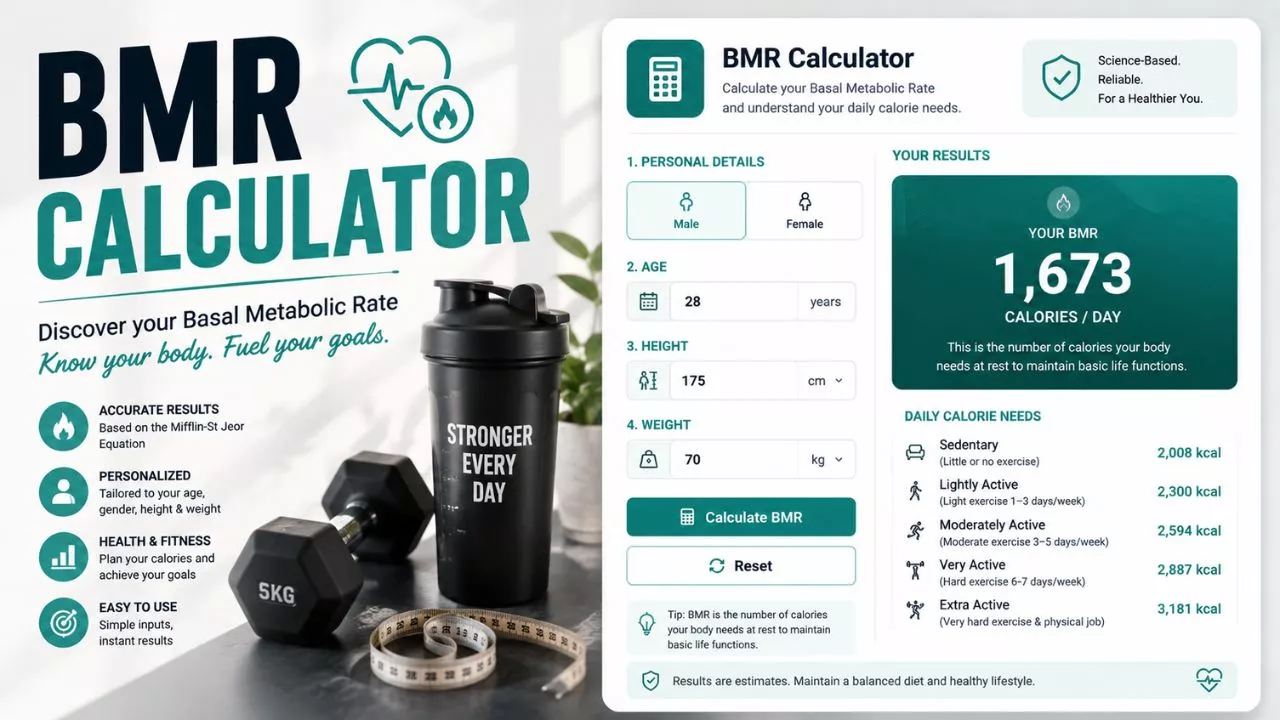
Your basal metabolic rate (BMR) refers to the minimum number of calories your body needs to function at a basic level. This includes maintaining all your cells and essential bodily functions, like breathing, blood circulation, and body temperature. BMR varies from person to person based on several factors.
Your BMR is your body’s major source of energy expenditure. It fulfills 60% to 70% of the total energy your body uses. Your body uses about 10% of its total energy to process food into fuel. The remaining energy fuels your physical movement.
You may want to learn more about BMR to help manage your weight. It can help provide a general understanding of what your body needs to function. But know that your BMR is just one piece of the puzzle when it comes to weight management and calorie usage.
How to Calculate BMR?
While you can calculate an estimated BMR using a BMR calculator (which utilizes the following formulas or accepted variations), calculations are only estimates. Your actual BMR is affected by many factors, as stated above.
- Men: BMR = 88.362 + (13.397 x weight in kg) + (4.799 x height in cm) – (5.677 x age in years)
- Women: BMR = 447.593 + (9.247 x weight in kg) + (3.098 x height in cm) – (4.330 x age in years)
Resting Metabolic Rate, or RMR, is the rate at which the body expends energy to maintain essential life functions while at rest, but can include the act of digestion or recent physical activity. RMR measurements will be slightly higher than BMR measurements.
Total Metabolic Rate, or TMR, is the cumulative energy required to maintain essential life functions as well as all physical activity, everything from grocery shopping to a strenuous workout. Even slight increases in muscle activity can significantly raise the metabolic rate during exercise and for several hours afterward.
How Is BMR Calculated?
There are different formulas that have been developed over time to calculate BMR. Our BMR calculator uses the Mifflin-St. Jeor’s equation to produce a BMR estimation. This equation will look at a few key individual variables, including:
- Age
- Sex
- Height
- Weight
Using these four variables, we can estimate your BMR. Your BMR provides valuable insight into how your body uses energy and what it will need to function, so that you can better estimate your caloric needs for weight loss and weight maintenance. This number can then be used to set weight loss goals and monitor caloric needs so that you can take better control over your health.
How to Use the BMR Calculator
To use this calculator, you will need to enter some basic information about yourself, including your:
- Age
- Sex
- Height (feet or centimeters)
- Weight (pounds or kilograms)
Enter values for each of these categories in the appropriate box and then click “Calculate your BMR” to generate a result. Once you have your BMR, you can apply your typical activity level to determine your daily caloric needs to maintain your current weight.
Why Should You Care About BMR?
- Set realistic calorie targets. Eating below BMR for too long can trigger adaptive thermogenesis, your body’s survival mechanism to conserve energy (Rosenbaum & Leibel, 2010).
- Choose the correct deficit or surplus. Knowing your baseline helps create a sustainable 300–500 kcal deficit for fat loss or a modest surplus for muscle growth.
- Spot metabolic changes. Aging, muscle gain/loss, hormonal shifts, or medications can nudge BMR up or down.
- Leverage biometric screenings. Many corporate wellness vendors include body-composition testing; BMR gives context to those reports and any program incentives.
Why Does BMR Matter?
Knowing your basal metabolic rate is most helpful if you’re focused on gaining weight, losing weight or maintaining your current weight. By understanding how much your body burns at rest, you can determine how much of those energy needs are met by your daily diet and make adjustments to help you reach your specific health goals.
BMR is important because it makes up the largest portion of most people’s daily energy expenditure, often 60% to 75%, says Davis. “Understanding your BMR helps provide insight into your overall calorie needs.
It’s a key consideration for nutrition, weight management, athletic performance, and ensuring you’re eating enough to support healthy hormone function, energy, and metabolism,” according to Davis.
Once you know your BMR, you can also use predetermined activity multipliers, such as in our calorie calculator tool, to estimate the true number of calories you burn daily based on your baseline needs and usual amount of movement.
By consuming more calories than this energy output with your diet, you’re likely to gain weight over time. By consuming fewer calories than this daily energy output, you’re likely to lose weight. And by matching this energy output, you can expect to maintain your current weight.
Generally, energy represented by your BMR accounts for about 70% of your daily calorie burn, as it maintains the function of important organs, including the heart, lungs, kidneys, liver, brain, skin, and more. Physical activity and nutritional factors like food digestion are responsible for the remainder of calories burned in a given day.
Factors That Affect BMR
Outside of controlled laboratory conditions, BMR isn’t an exact science. In fact, there’s a handful of variables that can affect the accuracy of a person’s BMR calculation, including:
- Age. The older you are, the lower your BMR tends to be.
- Muscle mass. Muscle requires more energy for maintenance than fat, so people with higher percentages of muscle mass can have higher BMRs.
- Diet. People who usually eat multiple small meals throughout the day tend to have a higher BMR than those who eat less frequently, larger meals. It’s also important to note that eating too little over a prolonged period of time can reduce BMR significantly, as it triggers the body’s instinct to store more energy rather than utilize it because the body anticipates a limited availability of incoming energy.
- Supplementation. Someone who uses certain drugs and supplements that act as stimulants, such as caffeine, can have a higher BMR than someone who doesn’t use these substances.
- Pregnancy. Supporting the life of a growing fetus is directly related to a higher BMR, which is why pregnant people often need to eat more than they did before pregnancy.
- Weather. When navigating extreme cool temperatures for a prolonged period of time, the body has to work harder to maintain its core temperature, which requires more energy, elevating your BMR.
Genetics can also impact BMR, says Davis, as some people have naturally faster or slower metabolisms. And hormones can be another factor, she says, noting, “Thyroid hormones, for example, play a major role in regulating BMR.”
How to Increase Basal Metabolic Rate
Many lifestyle modifications can help improve metabolism (or basal metabolic rate), particularly as it relates to maintaining a healthy weight and body composition. While exact results vary from one individual to another, experts recommend the following to promote a healthy metabolism:
- Eating a balanced diet of high-quality protein, complex carbohydrates, and healthy fats, prioritizing your protein consumption
- Consuming enough calories throughout the day to at least maintain your current BMR (calorie restriction ultimately slows metabolism)
- Drinking plenty of water daily
- Safely consuming natural stimulants like caffeine and capsaicin
- Increasing your total lean body mass
- Including interval training in your exercise regimen
- Prioritizing high-quality sleep each night